THE FRAGBRAG BLOG · A HISTORY OF INDIAN SCENT
The Evolution of Indian Perfumery: From Ancient Aromatics to Modern Fragrance Houses
From aromatic pastes and courtly rosewater to attar, sandalwood factories and modern fragrance houses: a researched journey through India’s changing scent culture.
By FragBrag · 11 November 2026 · History & craft
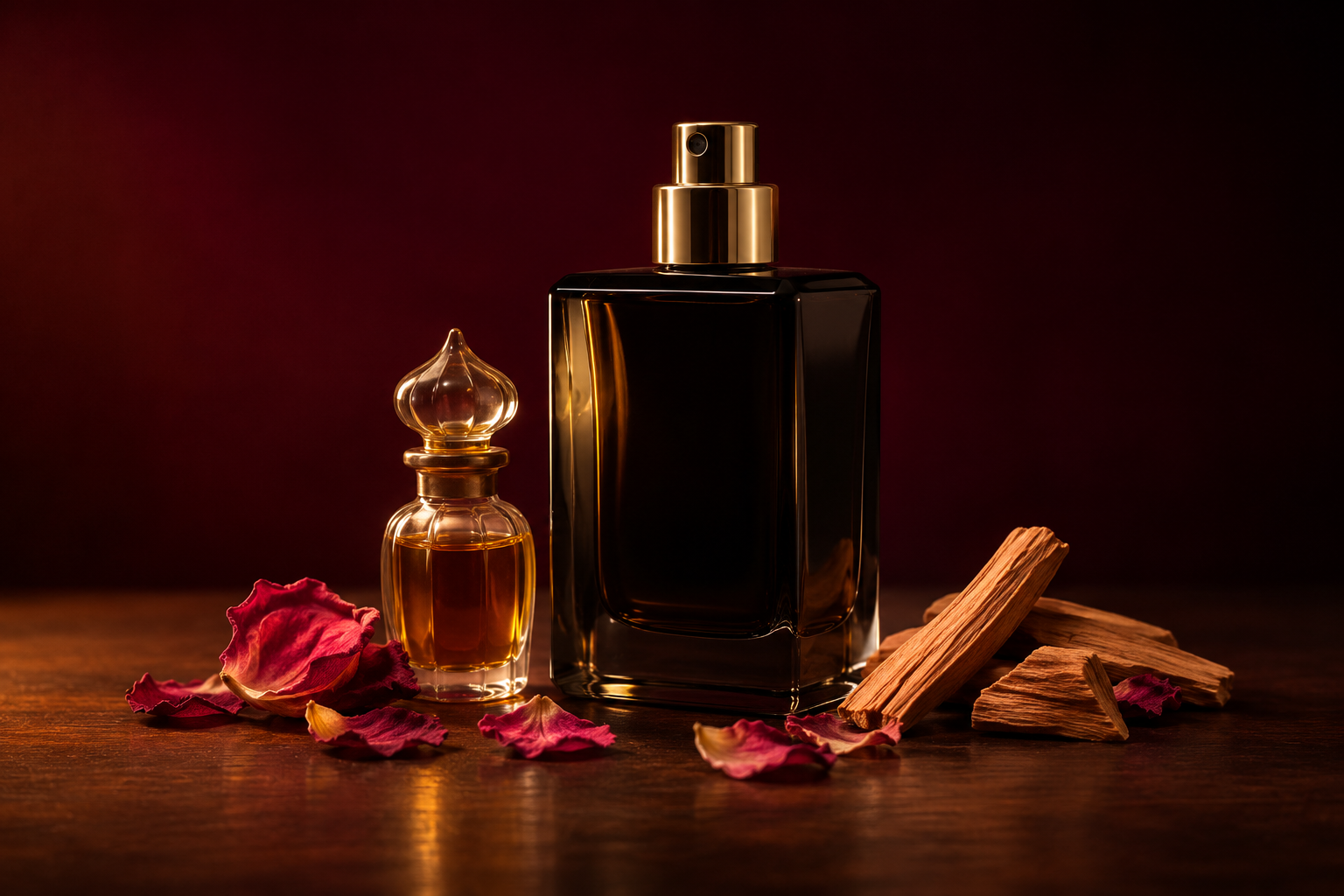
A little sandalwood paste, a room scented with incense, rosewater offered to a guest, a dab of attar and a modern atomizer: all belong in a history of Indian fragrance. Starting with the spray bottle alone leaves much of that story out.
India’s perfumery developed through overlapping traditions of ritual, grooming, hospitality, courtly taste, trade, distillation and industrial chemistry. The records do not reveal one inventor or a single, unchanged recipe handed down intact. They reveal people continually finding new ways to prepare, value and wear aromatic materials.
The journey at a glance
- Early textual traditions: fragrant woods, oils, powders and pastes appear in accounts of ritual and personal care.
- Sixth century CE: Varahamihira’s Brihat Samhita sets out perfume recipes and rules for combining ingredients.
- Around 1500: Mandu’s Ni‘matnama connects scent with food, betel and courtly pleasure.
- Late sixteenth–early seventeenth centuries: Mughal accounts document organised court perfumery and a celebrated rose-oil discovery.
- Nineteenth century: travellers record Kannauj’s perfumed waters in commerce.
- 1916–1950s: sandalwood research, factories and growing businesses add new industrial and commercial paths.
- 1991–2014: FFDC’s establishment and Kannauj Perfume’s GI registration provide institutional milestones.
- 2010s to today: modern Indian brands, specialist houses and aromatic-crop programmes widen the picture.
The sections below explain these milestones and link to the evidence behind them.
1. Ancient India: fragrance before the modern bottle
A study of ancient Indian literature by Prasad and colleagues surveys aromatic materials used for body anointing, massage oils, bathing preparations, fragrant powders and religious observances. It helps recover a wider vocabulary of scent than today’s retail categories allow. Historical perspective on perfumes in ancient Indian literature — Prasad et al., 2008.
These references establish a long history of using fragrance. They do not, by themselves, prove that every modern attar, extraction process or commercial brand existed in the same form in antiquity. A scented paste and a distilled perfume can share a material while belonging to different technologies and habits.
The Arthashastra also treats aromatic woods as valuable materials requiring judgement. In its treasury chapter, sandalwood and agarwood are differentiated by qualities including appearance and smell. The work’s composition and dating are complex, so it is better evidence for an early tradition of evaluating aromatic commodities than for one confidently dated “first perfume.” Arthashastra, Book II, Chapter 11 — translated by R. Shamasastry.
Read together, these sources suggest two foundations: fragrance had cultural uses, and its raw materials had economic value. That combination would remain significant as methods and markets changed.
2. The sixth century: perfumery as a technical art
Varahamihira’s sixth-century Brihat Samhita contains a chapter called Gandhayukti, concerned with preparing perfumes. In N. Chidambaram Iyer’s translation, it includes scented preparations for the hair, recipes using aromatic ingredients and rules for combining materials in different proportions. Brihat Samhita, Chapter 77: Gandhayukti — translated by N. Chidambaram Iyer.
This is a striking milestone because fragrance appears as something that can be formulated, varied and taught. The interest lies in relationships between ingredients, rather than a flower simply being pleasant to smell. For a present-day reader, it offers an early view of perfumery as skilled composition.
It would still be a leap to identify these recipes with a present-day eau de parfum or to treat the chapter as proof of today’s Kannauj apparatus. A historical recipe deserves to be understood on its own terms.
3. Before the Mughals: Mandu’s scented world
The Ni‘matnama, associated with the Sultans of Mandu around the end of the fifteenth century and the beginning of the sixteenth, gives another revealing perspective. Norah M. Titley’s translation presents recipes associated with Ghiyath Shahi and his son Nasir Shah. Aromatics appear alongside cooking and the preparation of betel; rosewater, sandal and other fragrant materials cross boundaries between flavour and perfume. Ni‘matnama of the Sultans of Mandu — Norah M. Titley, publisher preview.
This courtly manuscript matters because it predates the best-known Mughal perfume stories. It also challenges our habit of separating “beauty,” “food” and “fragrance” into sealed departments. In this particular elite setting, sensory pleasure connected them.
The manuscript is evidence of a court’s practices and aspirations, rather than a survey of every household. Keeping that distinction makes the history richer and more accurate.
4. Mughal perfumery: patronage, recipes and a rose-oil story
In the late-sixteenth-century Ain-i-Akbari, Abu’l Fazl describes Akbar’s interest in a perfume department. His account includes scented court halls, incense, flowers, oils for skin and hair, established recipes and new mixtures. Ain-i-Akbari, Volume I, Ain 30: On Perfumes — Abu’l Fazl, translated by H. Blochmann.
The picture is of patronage and organisation: scent was woven into the environment and presentation of the court. Mughal records are therefore central to this history, without making the Mughals the origin of all fragrance in India. Earlier texts and Mandu’s recipes already show an extensive aromatic world.
Jahangir’s memoirs contain the famous rose-oil episode. He attributes collecting fragrant oil from the surface of hot rosewater to Nur Jahan’s mother. This is more precise than the popular retelling in which Nur Jahan herself invents perfume. Memoirs of Jahangir, Volume I — translated by Alexander Rogers, edited by Henry Beveridge.
Even the emperor’s account should be read as a recorded courtly attribution, rather than proof that nobody anywhere had previously obtained rose oil. It describes a particular discovery celebrated within his reign. Nor should rose oil automatically be equated with every oil-based attar. Those distinctions keep an appealing story from becoming an unsupported universal claim.
5. Kannauj: a living craft, with more than a royal history
Kannauj’s present-day district guide describes traditional attar production through the deg-bhapka method: aromatic material is distilled and its fragrance received into a base oil. The guide names sandalwood or other natural oils as bases and identifies floral and other attars. Kannauj district administration — FFDC and traditional attar production.
The receiving oil matters. A traditional attar is not simply another name for any neat essential oil, and a roll-on container alone cannot tell you how its contents were produced. Asking about the material, base and method reveals more than relying on a romantic label.
There is also a useful nineteenth-century commercial snapshot. In Wanderings of a Pilgrim, published in 1850, Fanny Parkes records Kannauj rosewater and other perfumed waters being brought for sale during her travels. Fanny Parkes, Wanderings of a Pilgrim, Volume II, Chapter XL — 1850.
Her account is a visitor’s perspective, with the limitations of a colonial-era travel narrative. Nevertheless, the observation places perfumed waters in commerce, beyond an imperial recipe book. It helps us see why the craft’s history should include sellers, buyers and places of exchange, as well as famous rulers.
6. A wider scent map: Ganjam, Mysore and Assam
Kannauj is a major centre, but it cannot stand for the whole country. Coastal Ganjam in Odisha has a distinctive kewda tradition. The India Brand Equity Foundation’s regional profile describes aromatic products obtained from the male flowers of the screw-pine, including kewda water, attar and concentrated rooh. India Brand Equity Foundation — Odisha GI products: Ganjam Kewda.
This regional example changes the scale of the story: the flower, landscape, harvesting and processing community belong alongside the finished vial. A national history becomes clearer when we keep those local differences visible.
Southern India contributes another route through sandalwood and industrial science. IISc’s archival account describes research by J. J. Sudburough and H. E. Watson, followed by Maharaja Krishnaraja Wadiyar’s funding of an experimental sandalwood-oil factory near the institute in 1916; a second factory followed in Mysore in 1917. IISc, From the Archives — Connect, May 2015.
This adds a different kind of milestone: laboratory work, princely investment and production facilities developing around an aromatic material. The evolution of Indian fragrance includes these industrial settings as well as small-scale distillation.
The northeast also belongs in the picture. In its own history, Ajmal traces founder Haji Ajmal Ali’s journey from Assam to a perfume business in Mumbai in 1951, rooted in his experience with oudh. Ajmal — official company history.
These places should not be reduced to one national scent. Their materials and histories offer several ways into Indian perfumery, rather than a single formula that every Indian perfume must resemble.
7. The twentieth century: businesses, laboratories and training
Keva traces its origins to 1922, when Sadashiv Hari Kelkar and Vinayak Ganesh Vaze began a Mumbai enterprise selling attars, perfumes and cosmetics. Its subsequent fragrance and aroma-ingredient business illustrates another strand of the transition: organised companies serving a broader fragrance industry. The company distinguishes these origins from its incorporation in 1955. Keva — official company history.
It is tempting to tell the twentieth century as a simple story in which traditional perfume disappeared and later returned. The evidence here supports a more layered reading: inherited practices, new enterprises and industrial capabilities developed alongside one another.
Institutional support is part of that history. The Fragrance & Flavour Development Centre in Kannauj was established in 1991, with support involving the Government of India, UNDP, UNIDO and Uttar Pradesh. Its work links aromatic cultivation, processing, chemistry, quality assessment and training. Fragrance & Flavour Development Centre — official institutional profile.
That combination reminds us that perfume depends on more than inspiration. Learning how to handle a crop, operate a process and assess a material also shapes what can reach a perfumer’s bench.
Heritage gained a further formal milestone through geographical indication registration. The official Indian register for Kannauj Perfume, application 157, records a registration certificate dated 31 March 2014. The application was filed in 2009; the two dates should not be confused. Intellectual Property India — Kannauj Perfume, application 157.
This is a dated recognition of a regional product, not the date when Kannauj began making perfume. Modern administrative records and the much longer life of a craft answer different historical questions.
8. From the 2010s to now: several forms of Indian perfumery
Titan’s 2013 launch of SKINN offers one example of a modern Indian brand with international production. Titan’s launch account describes fragrances made and bottled in France with international perfumers, conceived for Indian consumers. Titan — French Fragrance Brought Home: SKINN, 2013.
Bombay Perfumery, meanwhile, dates its founding to 2016. The house describes an approach combining Indian memories and materials with ingredients sourced internationally. Its own account names Indian sourcing locations alongside materials from elsewhere. Bombay Perfumery — official history and approach.
These are examples of business approaches, rather than FragBrag product rankings or wear tests. They show why “Indian perfume” can refer to several things: an Indian-owned brand, a perfume manufactured in India, a composition containing Indian-grown materials, or a fragrance drawing on Indian experience. Those descriptions can overlap, but they are not interchangeable.
The agricultural side is evolving too. CSIR-CIMAP’s information brochure describes the Aroma Mission’s work across aromatic crops, distillation, value addition and market connections. CSIR-CIMAP — institutional information brochure, Aroma Mission.
Our reading of these developments is that the current story extends in both directions: towards recognisable finished brands, and back towards the fields and processing that supply aromatic materials. A convincing account of the present needs both. A beautifully designed bottle tells only part of the story.
What this history means for a curious perfume wearer
Begin with better questions. Who composed the perfume? Where was it manufactured? Which materials are identified, and where did they come from? Is “attar” describing a traditional production method, or being used more broadly for an oil perfume? A clear answer is more useful than an impressive age attached to a marketing story.
Then bring the history into your own life through FragBrag’s three aromas:
- Decode The Weather: keep notes on how a sample feels in the weather and indoor conditions you actually experience.
- Decode The Event: consider the setting, company and mood in which you want to wear it.
- Decode The Note: follow one material or scent idea across different compositions, describing what you personally notice.
The lasting interest of Indian perfumery is its capacity to carry memory while changing form. Reading its history carefully lets us appreciate both the craft we inherit and the choices makers are making today.
Research notes & further reading
This is a research-led historical feature, researched in November 2026. Historical texts are read in translation and reflect their particular settings; court accounts and travel narratives are not comprehensive records of everyday life. Company founding stories are identified as company accounts. Interpretive connections are FragBrag’s reading of the evidence. The article does not claim that an ancient recipe remained unchanged, establish a single inventor of Indian perfume, or report product testing.
The cover is an AI-created illustrative still life for FragBrag, not a reconstruction of a historical workshop or an image of a particular brand.
Historical texts and scholarship
- Historical perspective on perfumes in ancient Indian literature — Prasad et al., 2008
- Arthashastra, Book II, Chapter 11 — translated by R. Shamasastry
- Brihat Samhita, Chapter 77: Gandhayukti — translated by N. Chidambaram Iyer
- Ni‘matnama of the Sultans of Mandu — Norah M. Titley, publisher preview
- Ain-i-Akbari, Volume I, Ain 30: On Perfumes — Abu’l Fazl, translated by H. Blochmann
- Memoirs of Jahangir, Volume I — translated by Alexander Rogers, edited by Henry Beveridge
- Fanny Parkes, Wanderings of a Pilgrim, Volume II, Chapter XL — 1850
Institutions, regional craft and industry
- Kannauj district administration — FFDC and traditional attar production
- India Brand Equity Foundation — Odisha GI products: Ganjam Kewda
- IISc, From the Archives — Connect, May 2015
- Fragrance & Flavour Development Centre — official institutional profile
- Intellectual Property India — Kannauj Perfume, application 157
- CSIR-CIMAP — institutional information brochure, Aroma Mission
Company histories and launch records